
Most people picture an RFID tag as a sticker with a flat antenna. But some of the most demanding RFID products in the world look completely different. In ePassports, national ID cards and smart textiles, nobody prints or etches the antenna at all. Instead, it is a fine wire, and the chip connects directly to it. This is the world of chip-to-wire technology, and its newest offspring: E-Threads, RFID tags so thin they fit inside a single yarn.
In this article we explain how chip-to-wire works, how wire-embedded inlays are produced, what E-Threads are and where both technologies are used today.
What Is Chip-to-Wire Technology?
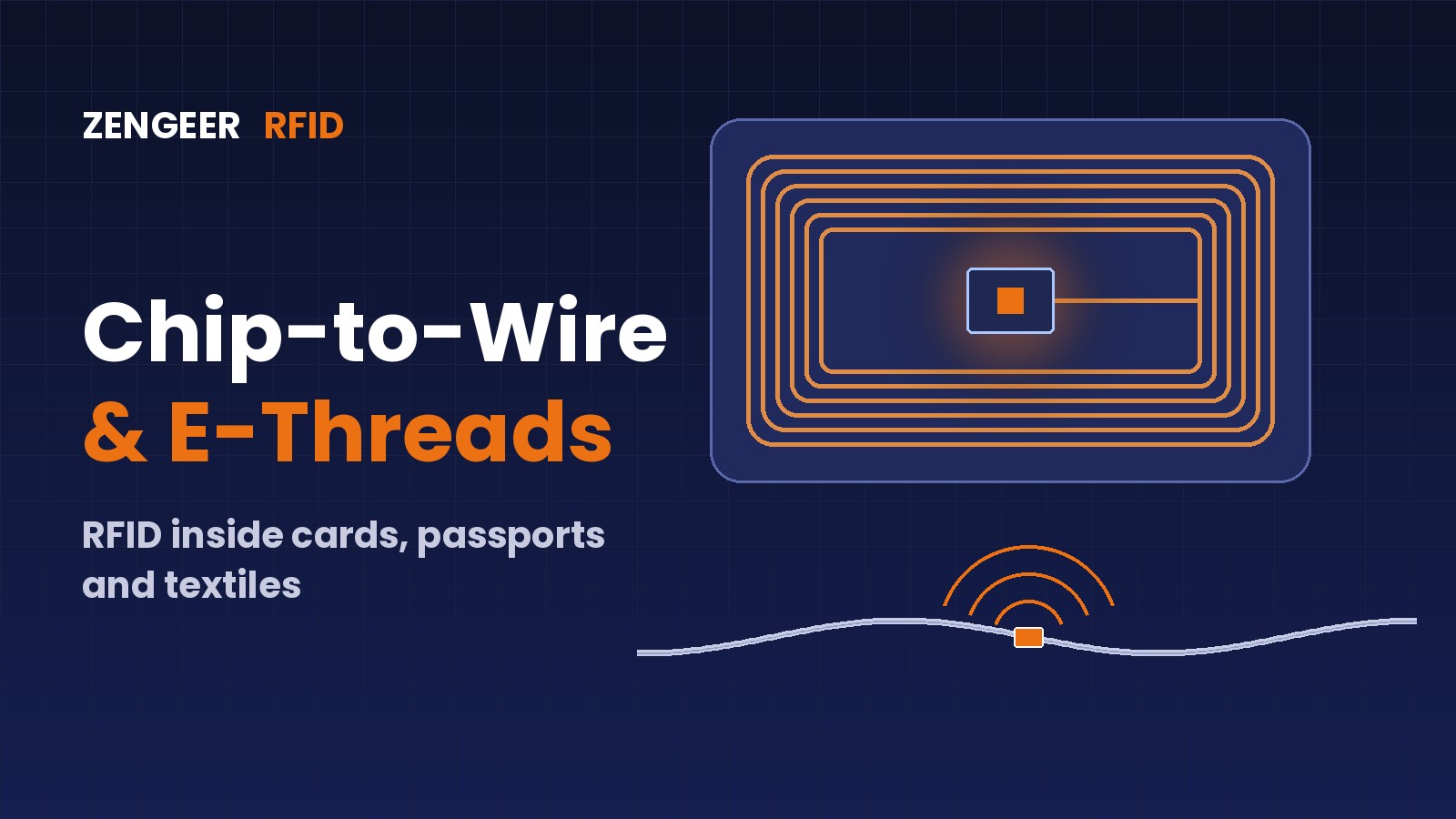
In a standard RFID label, manufacturers etch the antenna from aluminium or print it with conductive ink on a PET film, and then bond the chip onto pads of that flat antenna. In contrast, chip-to-wire (CTW) technology uses a thin, insulated copper wire as the antenna. The machine connects the ends of this wire directly to the chip or chip module, which creates a very robust electrical and mechanical joint.
Because the wire sits inside the product material, for example a polycarbonate card body, the result is an inlay that is extremely durable, flexible and almost invisible from the outside.
How a Chip-to-Wire Inlay Is Made
Production details vary by machine supplier and product. However, a typical chip-to-wire inlay line follows these steps:
- Substrate preparation: First, the operator loads sheets of PC, PVC or another card material into the machine, often in large multi-up formats.
- Wire embedding: Next, an ultrasonic head (sonotrode) guides the insulated copper wire along the antenna path and melts it into the surface of the sheet, turn by turn.
- Chip or module placement: Then the machine places the chip or chip module into a cavity at the defined position, aligned with the wire ends.
- Connection: After that, a bonding head connects the wire ends to the chip or module contacts, typically by thermocompression or welding. For this reason, heat, pressure and time need precise control.
- Electrical testing: The machine tests each inlay for resonance frequency and function before it moves on.
- Lamination: Afterwards, a lamination press combines the inlay with further layers (printed sheets, security features, overlays) into the final card or passport data page.
- Final test and personalization: Finally, the line tests the finished document again, then encodes and personalizes it with the holder’s data.
Each of these steps has a direct impact on yield. Wire tension, embedding depth, bond quality and lamination parameters decide whether an inlay survives a ten-year document lifetime or fails in the field. Read more about production optimization and quality improvement.
Where Chip-to-Wire Is Used
- ePassports and electronic visa documents
- National ID cards and residence permits
- Driving licences and health cards
- Contactless payment and access cards
- Transport and loyalty cards with high durability requirements
For this reason, most of these applications use HF RFID / NFC at 13.56 MHz, where a wound wire coil gives excellent and stable antenna performance.
Why Wire Antennas? The Key Benefits
- Durability: wire antennas handle bending, twisting and temperature changes over many years of daily use.
- Stable performance: copper wire coils offer low resistance and consistent electrical properties.
- Security: the antenna sits fully inside the card body, which makes tampering and removal very difficult.
- Design freedom: engineers can adapt the antenna shape and number of turns to each product.
E-Threads: RFID Inside a Single Yarn
In addition, the French company Primo1D, a spin-off of the CEA-Leti research institute founded in 2013. has taken the same idea one step further. Its E-Thread is a UHF RFID tag built into a textile thread.
In an E-Thread, a standard UHF RFID chip (typically around 445 × 490 micrometres or smaller) connects to two wire antenna segments that run along the thread. As a result, the whole assembly is so small that manufacturers can weave, sew or embed it into products during production. Published figures from Primo1D and RFID Journal include:
- Thread tag lengths of around 12 cm or 20 cm, depending on the application
- Read ranges reported up to about 12 metres with standard UHF readers, after improvements to the original design
- Resistance to around 100 machine washes, chemicals and heat, according to CEA
- Production capacity of several million units per year
Where E-Threads Are Used
- Apparel and retail: tags inside the garment itself instead of sewn-on labels, for inventory, returns, rental and second-hand markets.
- Laundry and linen: tracking textiles through industrial washing without labels that tear or fall off.
- Tires, cables and gaskets: traceability for flexible or irregularly shaped industrial products.
- Composites and medical products: identification built into the material.
- Anti-counterfeiting: a thread is almost impossible to see, find or remove, which makes copying and tampering much harder.
- Recycling and the Digital Product Passport: a tag that lives as long as the product can deliver data at end of life.
Chip-to-Wire vs Etched and Printed Antennas
| Etched / printed antenna | Chip-to-wire / E-Thread | |
|---|---|---|
| Antenna | Flat aluminium or ink on PET film | Insulated copper wire, embedded or inside a yarn |
| Typical products | Retail labels, logistics tags | ID documents, cards, textiles, industrial parts |
| Durability | Good for short to medium life | Very high, built for long lifetimes and stress |
| Visibility | Visible label | Hidden inside the product |
| Unit cost | Lowest at high volume | Higher, justified by durability and security |
The Production Challenges
Chip-to-wire production is precise work. The most common sources of yield loss we see are:
- Weak or inconsistent wire-to-chip bonds caused by wrong temperature, pressure or bonding time
- Wire positioning errors during embedding that shift the antenna or the wire ends
- Lamination stress that cracks bonds or damages chips
- Insufficient in-line testing, so defects only show up at the end of the line
- Material changes (wire, substrate, adhesive) that nobody validated before production
However, small improvements in these areas can make a large difference in output, scrap rate and customer complaints.
How Zengeer RFID Can Help
Zengeer RFID has hands-on background in chip-to-wire inlay technology, from R&D and machine design to software, testing and international ID document projects. Through our RFID manufacturing optimization services, we support manufacturers with:
- Process optimization and yield improvement for chip-to-wire and inlay lines
- Machine selection and supplier comparison before you invest
- FAT and SAT support and machine acceptance
- Operator training and technical documentation
- Feasibility studies for new products, including textile and E-Thread based solutions
Planning a Chip-to-Wire or Smart Textile Project?
Tell us about your product and production. We will show you the best next step, free and without obligation.
Frequently Asked Questions
What does chip-to-wire mean in RFID?
It means the RFID chip connects directly to a wire antenna instead of a flat etched or printed antenna. The technology is widely used in ID cards and passports.
Are E-Threads washable?
Yes. According to CEA, Primo1D’s E-Threads withstand around 100 machine washes as well as chemicals and high heat.
What frequency do E-Threads use?
E-Threads use UHF RFID, so they can be read with standard UHF readers over several metres, without line of sight.



Leave a Reply