

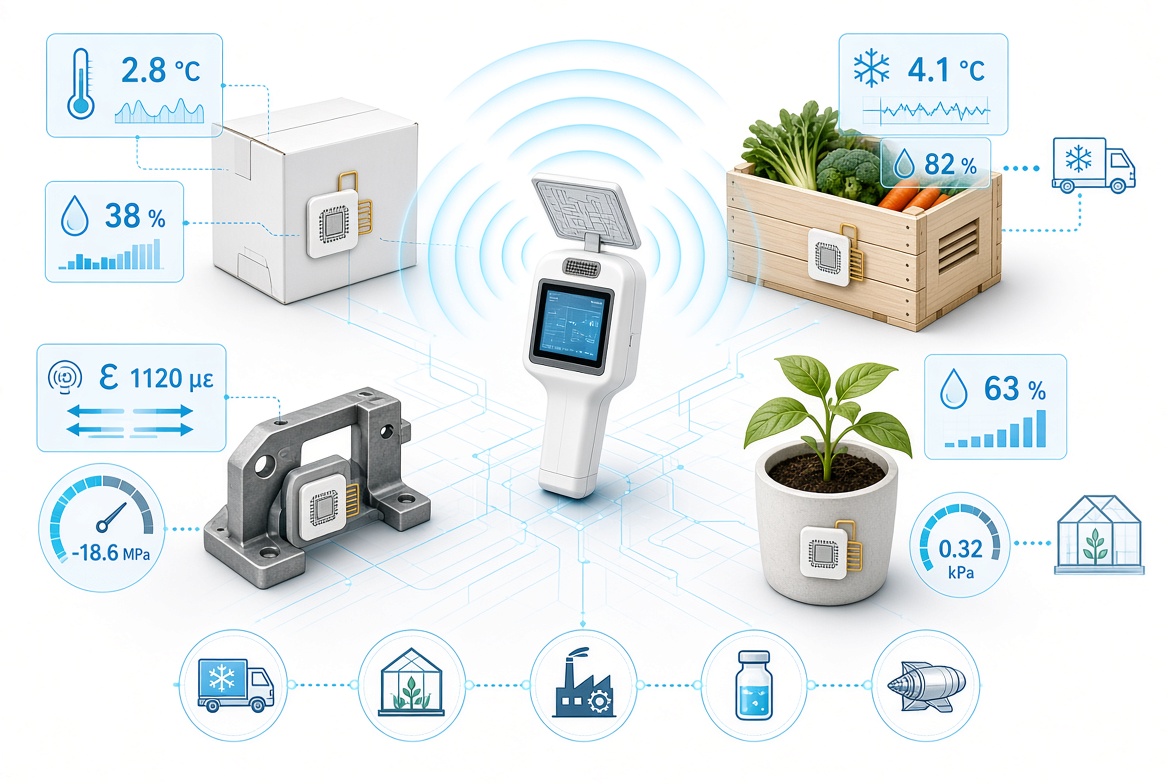
RFID has traditionally been used to answer a simple question:
“What is this object?”
A tag provides an identity, and a reader detects it.
But what if the RFID tag could also tell us something about the condition of the object?
What if it could detect temperature, humidity, deformation, pressure or other physical changes without requiring a battery?
This is where batteryless UHF RFID sensing becomes interesting.
From Identification to Sensing
Traditional passive UHF RFID tags are mainly designed for identification and tracking.
A reader sends RF energy to the tag. The tag uses this energy to power its chip and communicates its identification information back to the reader.
A sensor enabled RFID device adds another layer.
Instead of only providing an identification number, the RFID system can also collect information about the physical environment.
Depending on the sensor architecture, this can include:
Temperature
Relative humidity
Strain or deformation
Pressure
Light
Moisture
Motion
The result is a combination of identification and condition monitoring in the same wireless ecosystem.
How Can a Batteryless RFID Sensor Work?
The basic principle is similar to passive UHF RFID.
The reader transmits RF energy.
The RFID sensor receives part of this energy and uses it to operate the electronics and sensing function.
The measured information is then communicated back through the RFID link.
This creates an interesting architecture:
RFID Reader → RF Energy → Sensor → Measurement → RFID Communication → Data System
A batteryless UHF RFID sensor architecture can combine an integrated sensor or an interface for an external sensor with the RFID IC. The technical material describes operation with EPC Gen2 and reading ranges of up to several meters while supplying the sensor.
Why Remove the Battery?
Batteries can become a significant challenge when sensors are deployed in large numbers.
A battery powered sensor may require:
Battery replacement
Maintenance
Physical access
Additional packaging
Battery monitoring
End of life management
For applications involving thousands of sensors, these requirements can increase the complexity of the system.
Batteryless RFID sensing changes the approach.
If the RFID reader can provide the energy required for the sensing operation, the sensor can remain small and maintenance requirements can potentially be reduced.
The source material specifically identifies maintenance, deployment, cost and battery related limitations as challenges for industrial sensing applications.
Temperature Sensing
Temperature is one of the most straightforward applications.
A sensor enabled RFID tag can potentially provide temperature information when it is interrogated by a compatible reader.
This opens possibilities in:
Cold chain
Food logistics
Pharmaceutical transportation
Industrial equipment
Production environments
Storage environments
Agriculture
Healthcare
The application material includes temperature monitoring across industrial processes, logistics, automotive, agriculture and healthcare.
The important difference is that the RFID tag is no longer only identifying the product.
It is providing information about the product’s condition.
Humidity and Moisture Monitoring
Humidity can have a significant effect on products, materials and industrial processes.
RFID sensing can be used to investigate applications such as:
Moisture detection
Storage monitoring
Concrete drying
Food freshness
Agricultural environments
Condensation detection
Humidity control
For example, monitoring moisture during a concrete drying process could provide information about the condition of the material rather than simply recording where the material is located.
The technical use cases include humidity and moisture monitoring for construction, agriculture, logistics and aerospace applications.
Strain and Deformation Monitoring
Another interesting application is measuring mechanical deformation.
A sensor interface can be connected to technologies such as strain gauges or other resistive and capacitive sensing elements.
This creates possibilities for monitoring:
Mechanical stress
Deformation
Forces
Structural conditions
Load levels
Equipment condition
In industrial environments, this could complement traditional RFID tracking with information about the physical state of an asset.
Instead of only knowing:
“Where is the asset?”
the system could potentially provide:
“What condition is the asset in?”
The technical material describes sensor interfaces for strain gauges, thermocouples, piezoresistive sensors and other external sensing elements.
RFID Sensors in Industrial Applications
Industrial environments are particularly interesting because many assets are difficult to monitor continuously.
Potential applications include:
Predictive maintenance
High temperature monitoring
Equipment condition monitoring
Pressure monitoring
Vibration related monitoring
Electrical cabinet monitoring
Leak detection
Process monitoring
The reviewed material describes applications involving temperature, forces, vibration, pressure and humidity monitoring in industrial processes.
This creates a bridge between RFID and industrial condition monitoring.
Agriculture and Smart Farming
Agriculture is another area where batteryless sensing could be useful.
Potential applications include:
Soil moisture monitoring
Temperature monitoring
Greenhouse conditions
Water optimization
Seed storage
Livestock monitoring
Crop and production monitoring
For example, RFID sensing could combine the identity of an asset or location with environmental measurements.
The application material describes temperature, soil moisture, humidity and light monitoring across agricultural use cases.
Logistics and Cold Chain
Logistics creates another strong use case.
Traditional RFID can tell a company that a particular product passed through a specific location.
Sensor enabled RFID can potentially add environmental information to that event.
For example:
Product identified → Temperature measured → Location recorded → Event stored
This can be useful in cold chain applications where temperature conditions matter throughout transportation and handling.
The reviewed material includes temperature monitoring during loading, transportation and delivery, as well as moisture and other environmental monitoring for logistics applications.
Healthcare and Pharmaceuticals
Temperature sensitive medical products require controlled storage and transportation conditions.
Batteryless RFID sensing can potentially provide an additional layer of monitoring without requiring a battery in every sensing point.
Potential applications include:
Cold chain monitoring
Temperature sensitive products
Humidity monitoring
Patient environment monitoring
Medical product condition monitoring
The source material describes temperature monitoring for healthcare and pharmaceutical applications, as well as relative humidity monitoring.
Automotive and Aerospace
The concept also extends into demanding engineering environments.
In automotive applications, sensing can be used to investigate:
Tire temperature
Pressure
Deformation
Vibration
Production processes
Leak detection
The automotive use cases in the source material include temperature, pressure, deformation, vibration, leakage and production process monitoring.
In aerospace applications, potential applications include monitoring insulation panels, detecting pressure or vacuum related issues, monitoring shocks, temperature and condensation.
These applications show that RFID sensing does not have to be limited to inventory management.
It can become part of a broader condition monitoring architecture.
Existing RFID Infrastructure Can Become More Valuable
One of the interesting aspects of batteryless UHF RFID sensing is the possibility of using existing RFID infrastructure.
A sensing architecture based on standard UHF RFID communication can potentially use existing readers and software infrastructure, depending on the specific implementation.
The technical material describes compatibility with EPC Gen2 communication and operation with existing infrastructure.
This is important because companies do not necessarily want to build a completely separate wireless network for every new sensor application.
If identification, sensing and data collection can be combined, the infrastructure can potentially serve multiple purposes.
RFID + Sensors = More Context
The biggest change is not simply adding a sensor to an RFID tag.
It is adding context to identification.
Traditional RFID:
Who or what is this?
Sensor enabled RFID:
Who or what is this?
Where is it?
What is its condition?
What has changed?
This additional information can make RFID data more useful for automation, traceability, predictive maintenance and process optimization.
The Future of Batteryless IoT
Batteryless UHF RFID sensing sits at an interesting intersection between:
RFID
IoT
Wireless sensing
Industrial automation
Condition monitoring
Supply chain visibility
Smart manufacturing
The technology will not replace every battery powered sensor.
Applications requiring continuous operation, long range communication or higher energy consumption may still require other architectures.
But for applications where sensing can happen when a reader is present, batteryless RFID can offer an interesting alternative.
The combination of wireless identification, RF energy harvesting and sensing creates a new category of RFID applications.
RFID started by answering:
“What is it?”
The next generation of RFID applications can start answering:
“What is happening to it?”


Leave a Reply