

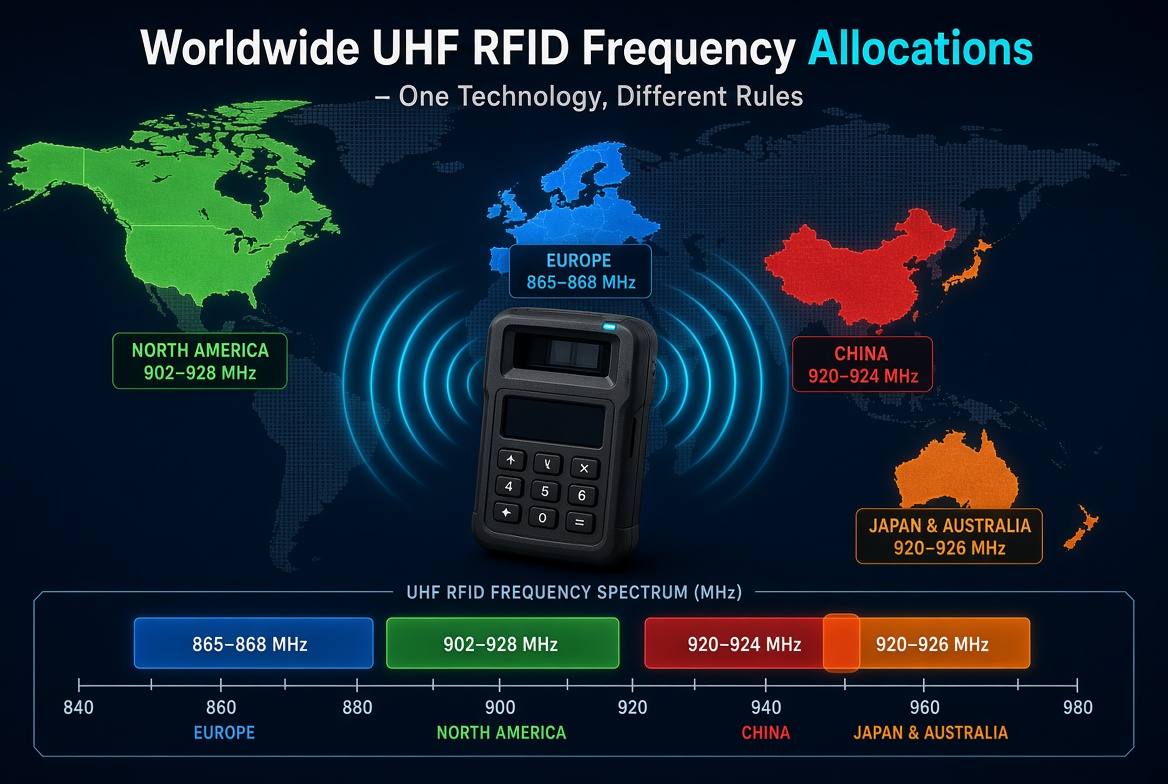
Why the same UHF RFID reader cannot simply be deployed everywhere
UHF RFID is a global technology, but the radio spectrum it uses is not globally uniform.
This is one of the first things companies should consider when designing an RFID system for multiple countries.
A reader that performs well in Germany may need different frequency settings when deployed in the United States, China, Japan or Australia.
The reason is simple:
RFID hardware must operate within the frequency regulations of the country where it is installed.
RAIN RFID systems generally operate within the 860–930 MHz UHF range, using the EPC Gen2 / ISO/IEC 18000 63 air interface.
But the permitted frequency range, transmission power and channel access method can be different from one country to another.
The most important difference: Europe vs. North America
One of the most common mistakes is assuming that 902–928 MHz is the global UHF RFID band.
It is not.
For example:
🇺🇸 United States: 902–928 MHz
🇨🇦 Canada: 902–928 MHz
While many European deployments use the lower ETSI band around:
🇩🇪 Germany: 865.6–867.6 MHz
Germany also has provisions for operation in the 916.1–918.9 MHz range under specific conditions, including defined center frequencies for 4 W ERP operation.
This difference has a direct impact on RFID reader configuration, antennas and overall RF performance.
UHF RFID Frequency Allocations by Region
Important: The table below is a practical overview based primarily on the GS1 Overview of UHF frequency allocations for RAIN RFID. National regulations can change, and additional conditions may apply. Always verify the current national regulation before deployment.
🇪🇺 Europe
| Country | UHF RFID Frequency | Power / Conditions |
|---|---|---|
| 🇩🇪 Germany | 865.6–867.6 MHz | 2 W ERP, ETSI |
| 🇫🇷 France | 865.6–867.6 MHz | 2 W ERP, ETSI |
| 🇫🇮 Finland | 865.6–867.6 MHz | 2 W ERP, ETSI |
| 🇬🇷 Greece | 865.6–867.6 MHz | 2 W ERP, ETSI |
| 🇦🇹 Austria | 865.6–867.6 MHz | 2 W ERP, ETSI |
| 🇧🇪 Belgium | 865.6–867.6 MHz | 2 W ERP, ETSI |
| 🇳🇱 Netherlands | 865.6–867.6 MHz | 2 W ERP, ETSI |
| 🇪🇸 Spain | 865.6–867.6 MHz | 2 W ERP, ETSI |
| 🇮🇹 Italy | 865.6–867.6 MHz | 2 W ERP, ETSI |
| 🇵🇱 Poland | 865.6–867.6 MHz | 2 W ERP, ETSI |
| 🇸🇪 Sweden | 865.6–867.6 MHz | 2 W ERP, ETSI |
| 🇨🇭 Switzerland | 865.6–867.6 MHz | National/ETSI conditions |
| 🇬🇧 United Kingdom | 865.6–867.6 MHz / additional provisions | National conditions |
The European upper band
Several European countries also have provisions around 916.1–918.9 MHz.
For example, GS1 lists for Germany a 4 W ERP option with interrogator transmissions permitted at center frequencies of:
916.3 MHz
917.5 MHz
918.7 MHz
France has similar provisions, with additional deployment declaration requirements.
This is an important detail when designing equipment intended for international European deployment.
🇺🇸 North America
| Country | UHF RFID Frequency | Typical Regulatory Approach |
|---|---|---|
| 🇺🇸 United States | 902–928 MHz | Up to 4 W EIRP, FHSS |
| 🇨🇦 Canada | 902–928 MHz | Up to 4 W EIRP, FHSS |
| 🇲🇽 Mexico | Around 902–928 MHz | National regulatory conditions |
North American RFID systems commonly use the 902–928 MHz region.
This is significantly different from the traditional European 865–868 MHz operating range.
Therefore, an RFID reader designed only around the European band cannot simply be configured for the US market without considering its RF architecture.
🇨🇳 Asia
| Country / Region | UHF RFID Frequency | Typical Conditions |
|---|---|---|
| 🇨🇳 China | 920.5–924.5 MHz | 2 W ERP, FHSS |
| 🇯🇵 Japan | 916.7–920.9 MHz | Specific power/channel/LBT conditions |
| 🇸🇬 Singapore | 866–869 MHz / 920–925 MHz | Different limits depending on band |
| 🇭🇰 Hong Kong | 865–868 MHz / 920–925 MHz | Different regulatory conditions |
| 🇰🇷 South Korea | Around 917–923.5 MHz | National regulatory conditions |
| 🇹🇼 Taiwan | Around 922–928 MHz | National regulatory conditions |
| 🇮🇳 India | Around 865–867 MHz | National regulatory conditions |
China is particularly interesting because its commonly used UHF RFID range is 920.5–924.5 MHz, rather than the European 865–868 MHz or North American 902–928 MHz bands.
Japan is another special case because frequency, power and channel access conditions need to be considered together.
🇦🇺 Oceania
| Country | UHF RFID Frequency | Typical Conditions |
|---|---|---|
| 🇦🇺 Australia | 920–926 MHz | Up to 4 W EIRP |
| 🇳🇿 New Zealand | Around 921–928 MHz | National regulatory conditions |
Australia is another example showing why an international RFID product needs regional RF configuration.
The commonly used Australian range is around 920–926 MHz, which sits between the European and North American approaches.
🌎 Latin America
Latin American markets are particularly important for global RFID manufacturers because regulatory conditions can vary between countries.
| Country | Common UHF RFID Region | Notes |
|---|---|---|
| 🇧🇷 Brazil | Around 902–928 MHz | National regulatory conditions |
| 🇦🇷 Argentina | Around 902–928 MHz | National regulatory conditions |
| 🇨🇱 Chile | Around 902–928 MHz | National regulatory conditions |
| 🇵🇪 Peru | Around 902–928 MHz | National regulatory conditions |
| 🇨🇴 Colombia | Around 902–928 MHz | National regulatory conditions |
For an actual deployment, the national regulator’s current requirements should always be checked rather than assuming that the North American configuration automatically applies.
🌍 Africa
African markets also require country-specific verification.
| Country | UHF RFID Region | Notes |
|---|---|---|
| 🇿🇦 South Africa | Around 915 MHz region | National regulatory conditions |
| 🇳🇬 Nigeria | Around 865–868 / 915 MHz depending on application/regulation | Verify current NCC requirements |
| 🇰🇪 Kenya | Around 865–868 MHz / national conditions | Verify current regulator |
| 🇪🇬 Egypt | National allocation | Verify current regulatory conditions |
| 🇲🇦 Morocco | National allocation | Verify current regulatory conditions |
For projects involving multiple African countries, the RFID system should therefore be validated against each country’s current spectrum rules before equipment is selected.
Why Does Frequency Matter So Much?
Because frequency is not just a software setting.
It influences the complete RF system.
Reader → Cable → Antenna → Tag → Environment
All of these components work together.
A change in frequency can affect:
• Antenna design
• Antenna impedance and tuning
• Tag antenna performance
• Read range
• Reader power configuration
• Channel availability
• Interference
• Regulatory compliance
• Overall system performance
GS1 also points out that RFID read performance depends on factors such as reader power, interference, antenna characteristics, polarization and tag orientation.
So the question shouldn’t simply be:
“Does this RFID reader support UHF?”
The better question is:
“Does this complete RFID system support the correct UHF band and regulatory requirements for the target country?”
ERP vs. EIRP: Another Detail That Matters
This is an area that is often overlooked.
Some regulations specify maximum power as ERP, while others use EIRP.
They are not the same reference.
Therefore, comparing:
4 W ERP
directly with:
4 W EIRP
can lead to an incorrect conclusion about the actual permitted radiated power.
For an international RFID deployment, the power limit needs to be interpreted together with the antenna gain, cable losses and regulatory definition being used.
What This Means for RFID Manufacturers
If you are developing an RFID reader, antenna or complete RFID system for international markets, frequency compliance should be considered at the beginning of the RF design.
Not after the hardware is finished.
A global RFID product may need:
Different regional configurations
rather than one universal RF configuration.
For example:
🇪🇺 Europe → 865–868 MHz
🇺🇸 USA → 902–928 MHz
🇨🇳 China → 920.5–924.5 MHz
🇯🇵 Japan → 916.7–920.9 MHz
🇦🇺 Australia → 920–926 MHz
The same reader platform may support several markets, but the RF implementation, firmware configuration, antenna and regulatory certification must be considered accordingly.
The Key Takeaway
UHF RFID is a global technology, but the RF spectrum is local.
A successful international RFID deployment therefore requires more than selecting a reader with a high read range.
You need to verify:
✅ Authorized frequency range
✅ Maximum permitted power
✅ ERP vs. EIRP
✅ Channel availability
✅ FHSS / LBT / applicable access method
✅ Reader configuration
✅ Antenna characteristics
✅ Tag performance
✅ National certification requirements
✅ Actual RF environment
And most importantly:
Design the RFID system around the regulations of the target market, not around the specifications of the hardware brochure.
For RFID manufacturers, system integrators and solution providers, this should be part of the RF design process from day one.
Sources
The primary reference for the frequency overview is GS1’s “Overview of UHF frequency allocations (860 to 930 MHz) for RAIN RFID.”
GS1 also confirms that RAIN RFID uses the UHF range and that the EPC Gen2 air interface is designed for the 860–930 MHz region.


Leave a Reply