
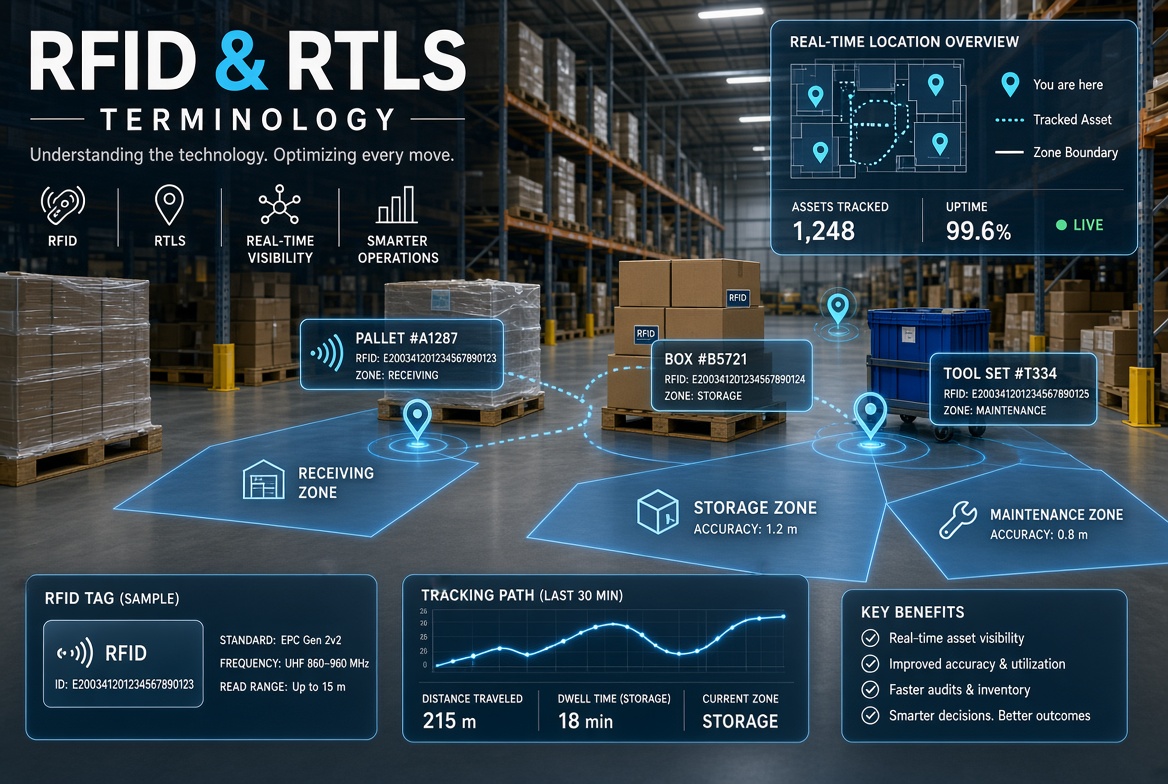
RFID and RTLS technologies are increasingly used to improve visibility, traceability, automation and operational efficiency across manufacturing, logistics, warehousing, healthcare and supply chains.
However, understanding RFID is not only about knowing what an RFID tag or reader is. The real value comes from understanding what can be tracked, where it can be tracked, and what decisions can be made from the collected data.
From asset tracking and inventory management to real-time location systems, geofencing, serialization and Digital Product Passports, these concepts form the foundation of modern RFID-based identification and tracking solutions.
Below are 36 essential RFID and RTLS terms that explain the most common applications and use cases.
1. Asset Tracking
Asset Tracking is the process of tracking the location and movement of physical assets using technologies such as RFID.
Assets can include production equipment, tools, containers, pallets, machines or other valuable items.
RFID allows companies to identify assets automatically and reduce the need for manual searching or recording.
Example: A factory can use RFID to determine where a specific production tool is located and when it was last used.
2. Inventory Tracking
Inventory Tracking means automatically identifying, counting and locating products and stock using RFID.
Instead of manually scanning individual products, RFID systems can identify multiple tagged items automatically.
Example: A warehouse can perform an inventory check by moving an RFID reader through storage areas rather than manually scanning every product.
3. Item-Level Tracking
Item-Level Tracking means tracking individual products, where each item has its own unique RFID identity.
This provides much more detailed visibility than tracking only boxes, pallets or containers.
Example: Every individual pharmaceutical package can have its own RFID identity and tracking history.
4. WIP Tracking – Work in Progress
WIP Tracking refers to tracking parts and products as they move through different production stages and workstations.
RFID can automatically identify when a product enters or leaves a particular process.
Example: A manufacturer can see whether a specific product is waiting for assembly, undergoing testing or ready for final inspection.
5. Traceability
Traceability is the ability to track a product’s history throughout its lifecycle.
This can include information about:
- Production
- Processing
- Testing
- Quality inspection
- Storage
- Transportation
- Delivery
RFID can connect the physical product with its digital production and logistics history.
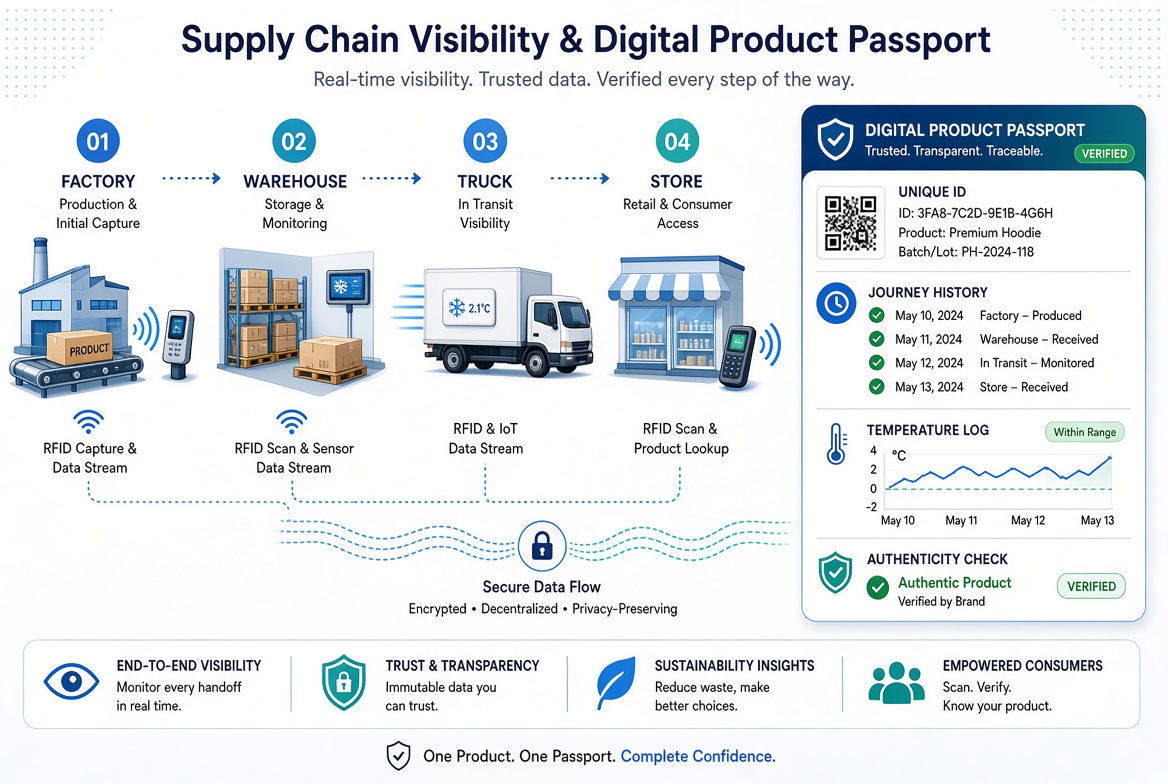
6. Supply Chain Visibility
Supply Chain Visibility means having a clear view of where products are and what is happening to them throughout the supply chain.
RFID can provide automatic identification events across manufacturing plants, warehouses, distribution centers and logistics operations.
The objective is not simply to know where something is, but also to understand what happened to it and when.
7. Yard Management
Yard Management involves tracking trailers, trucks, containers and other vehicles within an outdoor yard or facility.
RFID and other identification technologies can help companies determine:
- Which vehicles are on-site
- Where they are located
- When they arrived
- When they left
- Which loading area they used
8. Vehicle Tracking
Vehicle Tracking means automatically monitoring the location, movement and usage of vehicles.
Depending on the application, RFID can be used for vehicle identification at gates, checkpoints, parking areas or operational zones.
RFID can also be combined with GPS or other technologies when continuous location information is required.
9. Tool Tracking
Tool Tracking involves tracking production tools, equipment and specialized tooling.
This is particularly valuable in manufacturing environments where tools are expensive, shared between employees or frequently moved between workstations.
RFID can help answer a simple but important question:
Where is the tool right now?
10. Returnable Asset Tracking
Returnable Asset Tracking means tracking reusable assets such as:
- Pallets
- Totes
- Containers
- Roll cages
- Reusable packaging
These assets circulate repeatedly between suppliers, factories, warehouses and customers.
RFID can help companies reduce asset loss and understand circulation cycles.
11. Chokepoint Tracking
A Chokepoint is a defined location through which assets or products must pass.
Examples include:
- Doors
- Conveyors
- Gates
- Checkpoints
- Production entrances
RFID can automatically detect when a tagged object passes through such a point.
This makes chokepoints useful for creating automatic movement events.
12. Portal Tracking
Portal Tracking uses RFID readers and antennas positioned around a passageway or portal to detect tagged products or assets as they pass through.
For example, an RFID portal can be installed at a warehouse entrance.
When tagged pallets pass through the portal, the system can automatically record the movement.
13. Dock Door Tracking
Dock Door Tracking identifies which loading or unloading dock a product, pallet or vehicle passes through.
RFID readers can be installed around dock doors to automatically associate products with specific loading locations.
This can improve shipping accuracy and reduce manual checking.
14. Location Tracking
Location Tracking means automatically determining where an RFID-tagged asset is located.
The level of precision depends on the technology and system architecture.
Some systems determine only the general zone, while others can estimate a much more precise position.
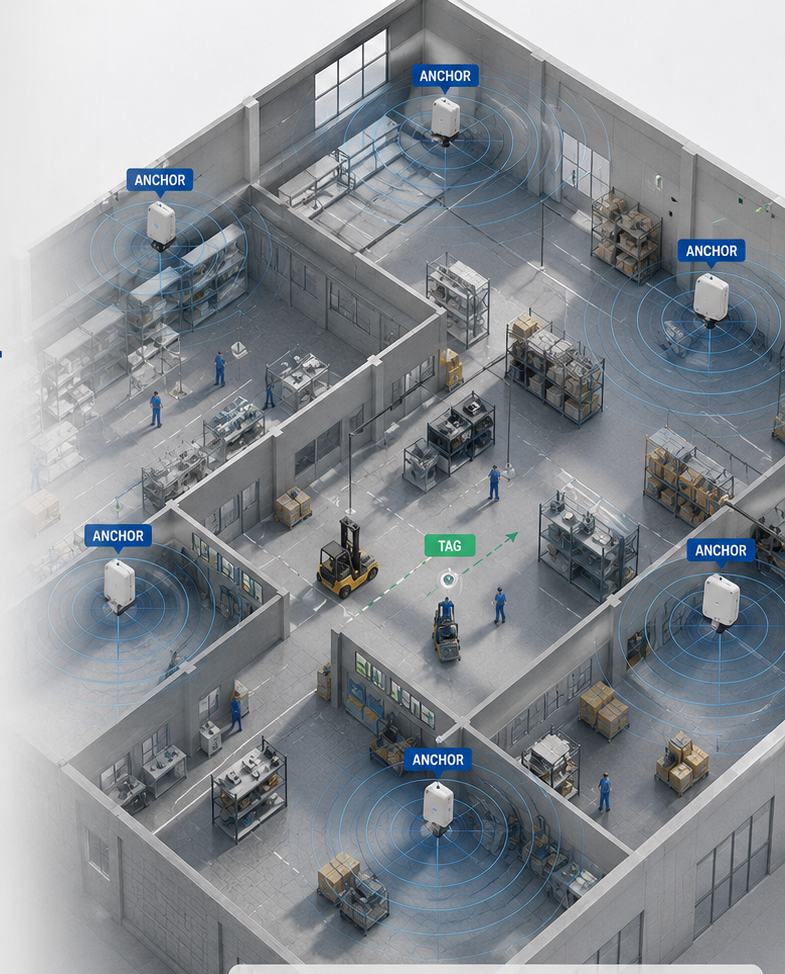
15. RTLS – Real-Time Location System
RTLS, or Real-Time Location System, is a technology system designed to determine the location of assets, products, vehicles or people in real time or near real time.
RTLS can use different technologies, including:
- RFID
- UWB
- BLE
- Wi-Fi
- GPS
Therefore, RTLS is a broader concept than RFID.
RFID can be one of the technologies used to build an RTLS solution.
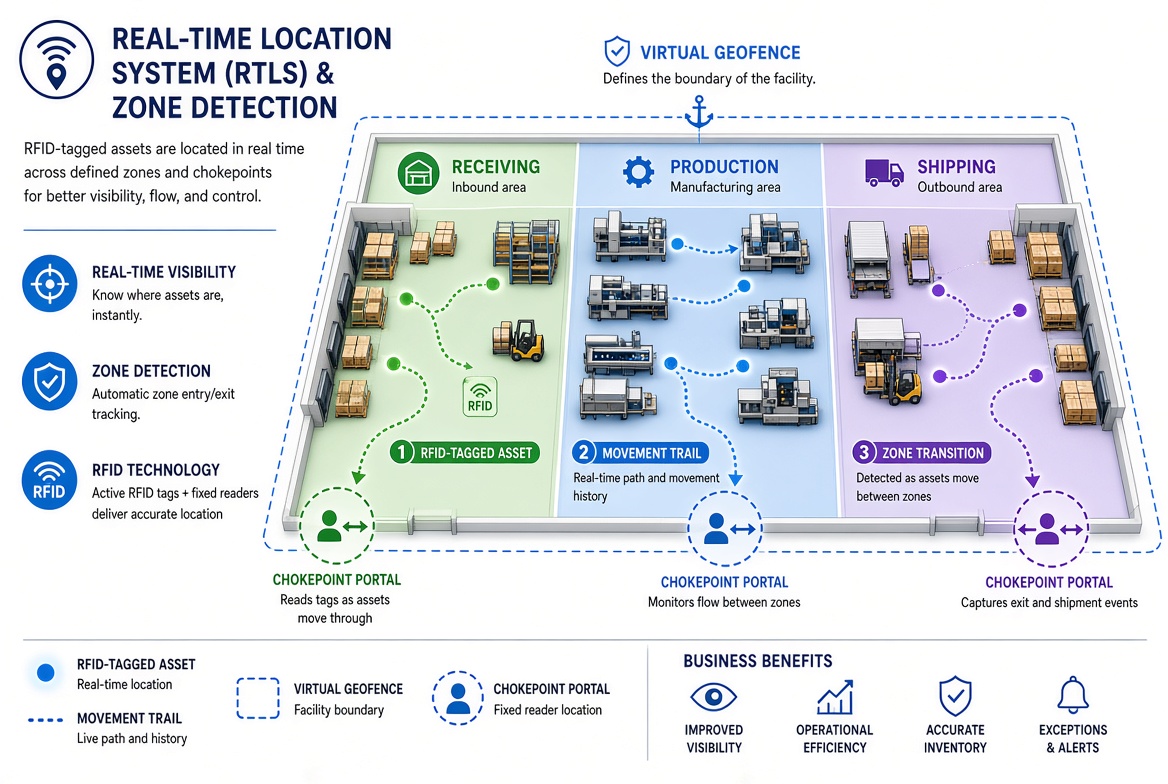
16. Zone Detection
Zone Detection determines which predefined area an asset is currently located in.
Instead of calculating exact coordinates, the system identifies the relevant zone.
For example:
Warehouse A → Production Area → Testing Area → Shipping Area
This can be sufficient for many industrial applications.
17. Geofencing
Geofencing creates virtual boundaries around a defined physical area.
When an asset enters or leaves the defined area, the system can automatically generate an event or trigger an action.
Example: A company can receive an alert when an expensive machine leaves an authorized production area.
18. Process Tracking
Process Tracking means automatically monitoring the progress of a product, part or work order throughout a production process.
RFID events can provide visibility into which production stage has been completed and what the next step should be.
This can help identify bottlenecks and process deviations.
19. Line Sequencing
Line Sequencing means delivering the correct parts to the production line at the correct time and in the correct sequence.
This is especially important in complex manufacturing environments where different product variants require different components.
RFID can help connect physical parts with production orders and sequences.
20. FIFO Management
FIFO stands for First In, First Out.
FIFO Management means using inventory according to the principle that the oldest inventory should be used first.
RFID can automatically identify when products entered storage and support systems in determining which items should be used or shipped first.
This can be particularly useful for products with limited shelf life.
21. Quality Tracking
Quality Tracking connects quality information with the identity of a specific product.
RFID can be used to associate a product with:
- Inspection results
- Test results
- Quality status
- Production data
- Rework history
This creates a stronger connection between the physical product and its digital quality record.
22. Serialization
Serialization means assigning a unique identity to every individual product or component.
For example:
Product A → Serial Number 000001
Product B → Serial Number 000002
Product C → Serial Number 000003
When RFID is used for serialization, every tagged item can be individually identified and tracked throughout its lifecycle.
23. Anti-Counterfeiting
Anti-Counterfeiting refers to technologies and processes used to help verify product authenticity and identify potentially counterfeit products.
RFID can provide a unique product identity that can be checked during different points in the supply chain.
Additional security mechanisms can be combined with RFID to strengthen authentication.
24. Cold Chain Monitoring
Cold Chain Monitoring involves monitoring temperature-sensitive products throughout storage and transportation.
Examples include:
- Pharmaceuticals
- Vaccines
- Food
- Biological materials
RFID sensor technologies can be used to monitor temperature conditions and provide information about whether required conditions have been maintained.
25. Condition Monitoring
Condition Monitoring means monitoring physical conditions such as:
- Temperature
- Humidity
- Vibration
- Shock
- Pressure
When sensors are combined with identification technologies, companies can connect environmental data with a specific asset, product or shipment.
26. Maintenance Tracking
Maintenance Tracking involves monitoring equipment usage, location, maintenance activities and service history.
RFID can help identify equipment automatically and connect it with maintenance records.
For example, technicians can scan or automatically identify an asset and access its maintenance history.
27. Work Order Tracking
Work Order Tracking means monitoring the status and progress of work orders throughout a production or service process.
RFID can connect a physical product or component with its corresponding work order.
This can improve visibility into which orders are:
Waiting → In Production → Testing → Completed → Shipped
28. Access Control
Access Control uses identification technologies to control and monitor access to specific areas, facilities or assets.
RFID credentials can be used to identify authorized personnel or objects.
For example, an RFID-based system can determine whether an employee has permission to enter a restricted production area.
29. Loss Prevention
Loss Prevention uses identification and tracking technologies to detect unauthorized movement of products or assets.
RFID can create automatic movement events at doors, gates or other defined points.
If an asset moves through an unauthorized location, the system can generate an alert.
30. Smart Shelf
A Smart Shelf uses RFID technology to automatically detect products placed on a shelf.
Instead of manually checking inventory, the system can identify which tagged items are present and monitor changes.
Potential applications include:
- Retail
- Healthcare
- Warehousing
- Manufacturing
- Spare parts management
31. Automated Inventory
Automated Inventory means automatically counting and monitoring inventory without relying entirely on manual counting.
RFID can identify multiple items simultaneously, making inventory operations faster and reducing manual scanning.
The result can be more frequent and more efficient inventory checks.
32. Asset Utilization
Asset Utilization measures how frequently and for how long an asset or piece of equipment is actually being used.
Knowing where an asset is located is useful.
Knowing how much it is being used can be even more valuable.
Companies can use utilization data to identify underused equipment, improve resource allocation and make better investment decisions.
33. Dwell Time Monitoring
Dwell Time is the amount of time a product, vehicle or asset remains in a particular location or process stage.
For example:
Receiving → 2 hours
Production → 5 hours
Quality Inspection → 3 hours
Shipping → 1 hour
RFID events can automatically provide the timestamps required to calculate these durations.
34. Exception Management
Exception Management means automatically identifying situations where the actual process differs from the expected process.
For example:
Expected:
Production → Quality Check → Shipping
Actual:
Production → Waiting → Waiting → Quality Check
The RFID data can help identify the unexpected delay and notify the responsible team.
35. Event Tracking
Event Tracking means automatically recording important events related to products, assets or processes.
Examples include:
- Asset entering a zone
- Product leaving a production station
- Pallet passing through a portal
- Vehicle entering a yard
- Product reaching a loading dock
These events create the data foundation for many RFID applications.
36. Digital Product Passport – DPP
A Digital Product Passport (DPP) is a digital record connected to a product that can contain information about its identity, characteristics, materials, history, sustainability and other relevant data.
RFID can be one of the technologies used to connect the physical product to its digital information.
The concept becomes particularly important as industries move toward greater product transparency, traceability and circular-economy models.
How These Concepts Connect
These 36 terms should not be viewed as completely separate RFID applications.
They are often connected together in a single solution.
For example, consider a manufacturing company:
RFID Tag
↓
Item-Level Identification
↓
WIP Tracking
↓
Process Tracking
↓
Quality Tracking
↓
Traceability
↓
Inventory Tracking
↓
Supply Chain Visibility
↓
Digital Product Passport
At the same time, location-related technologies can provide:
Location Tracking
↓
Zone Detection
↓
Portal / Chokepoint Tracking
↓
RTLS
↓
Geofencing
The RFID system therefore becomes more than an identification system. It becomes a source of operational data that can support automation, visibility, traceability and decision-making.
RFID vs. RTLS: What Is the Difference?
One of the most important distinctions is between RFID and RTLS.
RFID primarily provides identification and data capture using radio frequency technology.
RTLS focuses on determining the location of an object, asset or person in real time or near real time.
There is significant overlap between the two.
For example:
RFID:
“Which tagged pallet passed through this portal?”
RTLS:
“Where is this pallet right now?”
Depending on the application, RFID can therefore be part of a broader RTLS architecture.
From Identification to Intelligence
The evolution of RFID solutions can be viewed in several stages:
1. Identify
What is it?
RFID provides a unique identity.
2. Detect
Did it pass this point?
Portals, chokepoints and dock doors generate movement events.
3. Locate
Where is it?
Zone detection and RTLS provide location information.
4. Track
What happened to it?
Process tracking and traceability create a history.
5. Monitor
What is its condition?
Sensors can provide temperature, humidity, vibration and other data.
6. Analyze
What can we learn from the data?
Dwell time, asset utilization, exceptions and process performance can be analyzed.
7. Act
What should happen next?
The system can trigger alerts, workflows, production actions or business decisions.
This is where RFID moves from a simple identification technology toward a broader digital operational infrastructure.
Conclusion
Understanding RFID terminology is essential for designing effective RFID and RTLS solutions.
Whether the objective is inventory automation, production visibility, asset management, traceability, quality control, cold chain monitoring or real-time location tracking, the underlying concepts are closely connected.
The most successful RFID projects do not start with the question:
“Where can we install RFID readers?”
They start with:
“What do we need to identify, track, monitor or improve?”
Once the business objective is clear, the appropriate RFID tags, readers, antennas, sensors, software architecture and system design can be selected around that objective.
RFID is therefore not simply about tags and readers.
It is about connecting physical objects with digital information and turning movement into actionable data.


Leave a Reply