

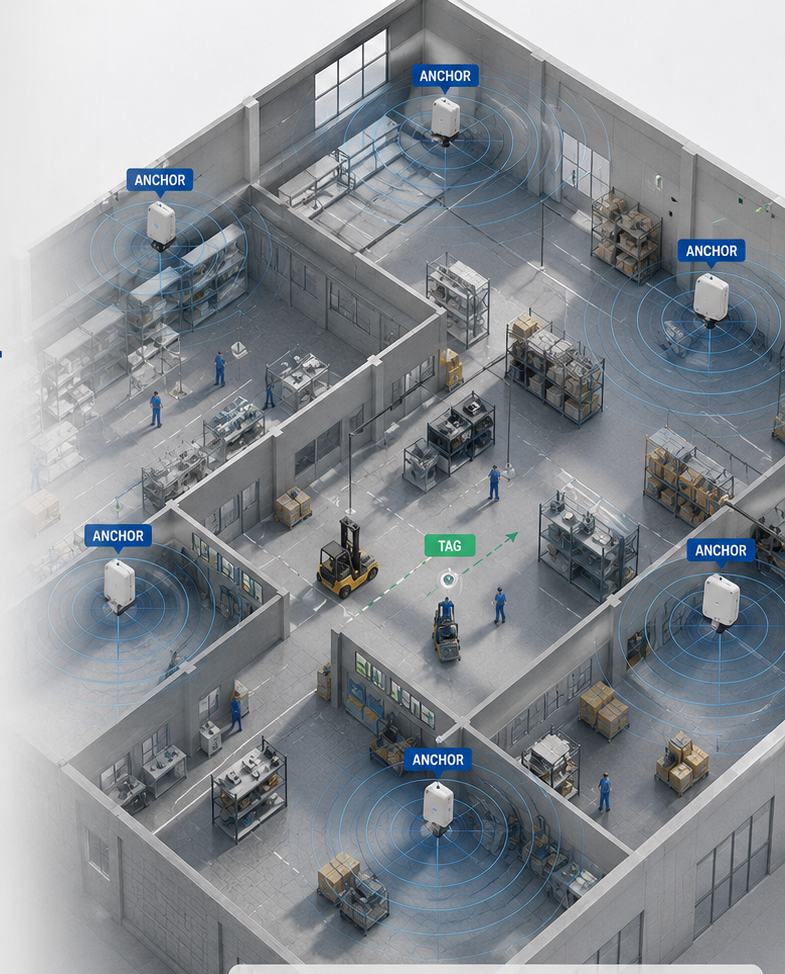
In the world of asset tracking and industrial automation, there is a common temptation to assume that more is always better. More data, more speed, and especially, more accuracy. When planning a Real-Time Location System (RTLS) deployment, it is easy to get caught up in the appeal of sub-meter precision.
However, a harsh reality often catches up with engineering and operations teams: sometimes, buying more accuracy can actually make an RFID project worse.
Here is why chasing extreme precision can backfire, and how to shift your approach to guarantee a successful deployment.
The Hidden Costs of Extreme Precision
High-precision RTLS systems, such as Ultra-Wideband (UWB), promise incredible pinpoint accuracy. But that precision does not happen in a vacuum. It comes with a steep price that goes far beyond the initial invoice:
- Heavy Infrastructure: Achieving sub-meter accuracy usually requires a dense network of anchors and readers scattered across your facility.
- Intense Calibration: These systems demand rigorous initial calibration and ongoing fine-tuning to maintain their precision.
- Massive Investment: More hardware, specialized software, and complex installation mean your upfront capital expenditure (CAPEX) and operational expenses (OPEX) skyrocket.
The Reality of a Dynamic Factory Floor
Even if you have the budget to build a high-precision infrastructure, you are fighting against a fundamental truth: industrial environments do not stay perfectly still.
Modern warehouses and manufacturing plants are living, breathing ecosystems.
- Machines are relocated to optimize workflows.
- Facility layouts change to accommodate new product lines.
- Assets inevitably move outside of their expected, highly calibrated areas.
- Radio Frequency (RF) conditions constantly shift as inventory piles up or clears out.
When your environment changes, a system reliant on rigid, high-precision parameters can easily degrade. You may find yourself in a frustrating position where you paid a premium for sub-meter accuracy, but due to daily operational shifts, you are operating at a much lower practical accuracy. The system becomes a high-maintenance burden rather than a productivity booster.
The Question That Saves Budgets
To avoid falling into the accuracy trap, you need to flip the script on how you evaluate technology. Before you look at a single vendor data sheet or compare hardware specs, there is one question that must come first:
“What business decision requires this level of accuracy?”
Do your forklift drivers need to know an asset is within a 10-centimeter radius, or do they just need to know which specific zone or bay it is parked in? Does your ERP system need to update the exact GPS coordinate of a pallet, or does it simply need a timestamp showing it passed through a specific dock door?
If a zone-based, standard RFID system can trigger the exact same operational decision as an expensive, hyper-precise RTLS network, the extra precision is just expensive noise.
Start with the Decision, Not the Tech
Technology should always serve strategy. When designing your next asset tracking project, follow this simple framework:
- Identify the Business Decision: Pinpoint the exact action or decision your team needs to make based on location data.
- Define the Necessary Accuracy: Determine the minimum level of precision required to reliably make that decision.
- Choose the Technology: Select the system (whether it is passive RFID, BLE, or UWB) that sustainably meets that threshold.
By starting with the decision and then choosing the technology—not the other way around—you will protect your budget, reduce system complexity, and build a resilient tracking solution that actually delivers on its ROI.


Leave a Reply