

Self-checkout has become a standard part of modern retail. But as adoption increases, so does the importance of understanding the losses associated with it.
ECR Retail Loss recently published its 2026 Self-Checkout Loss Report, building on its original 2018 research. The new study includes data from 39 retailers representing more than €1 trillion in combined turnover, compared with 13 retailers and €586 billion in the 2018 study.
The results show an interesting shift:
Self-checkout still increases retail loss, but the impact appears to be more manageable than it was in 2018.
2018 vs. 2026: The Big Picture
| Metric | 2018 Study | 2026 Study |
|---|---|---|
| Retailers included | 13 | 39 |
| Combined turnover | €586B | >€1T |
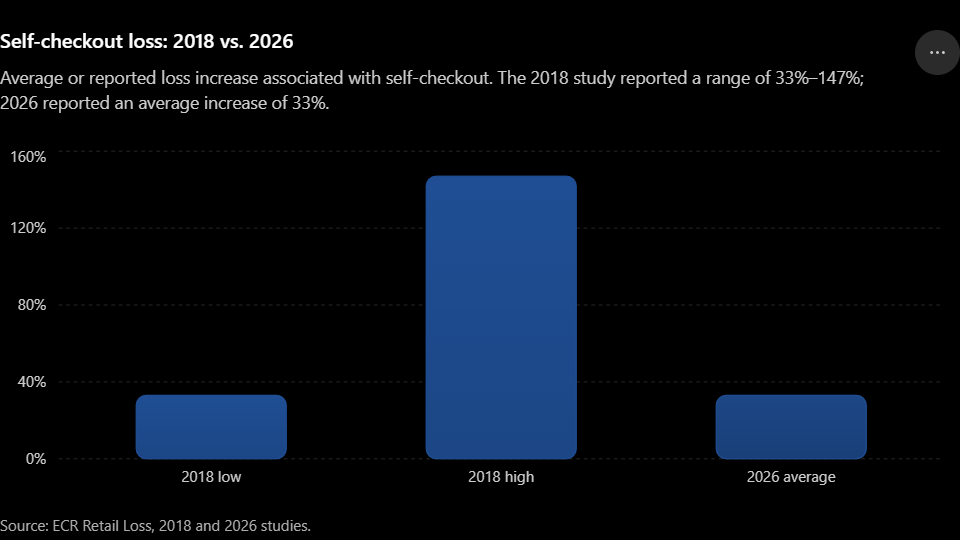
| Average loss increase with SCO | 33%–147% | 33% |
| Loss increase after implementation | — | 22% |
| Average absolute loss difference | — | +0.26 percentage points |
| Additional loss per 1% SCO utilisation | 0.01% | 0.030–0.048% |
| Average SCO transaction share | Early-stage adoption | 54% |
| Main loss mechanism | Non-scanning | Missed-scan |
| Highest-value loss mechanism | — | Walkaways (€88) |
The comparison shows that retailers appear to have become better at controlling self-checkout losses. In 2018, stores with SCO reported losses 33% to 147% higher than stores without SCO. In the 2026 research, the average difference was 33%.
Self-Checkout Is No Longer a Secondary Checkout
One of the biggest changes since the original research is the scale of adoption.
Among the retailers participating in the 2026 study:
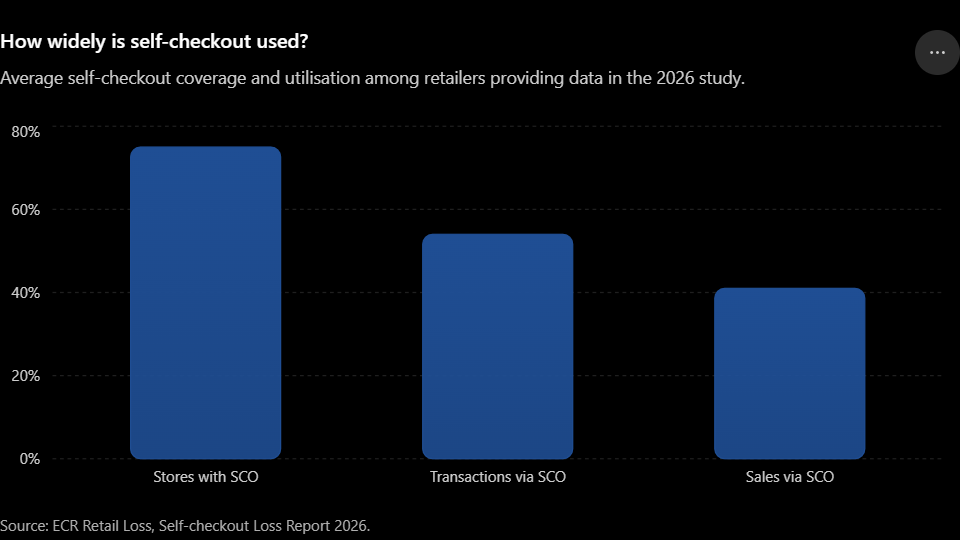
- 75% of stores had self-checkout.
- 54% of transactions in stores with SCO went through self-checkout.
- 41% of sales in those stores went through SCO.
This means self-checkout is no longer simply an additional checkout option. In many stores, it has become the preferred transaction method for customers.
More Self-Checkout Usage Means More Risk
The 2026 research found a clear relationship between SCO utilisation and retail loss.
Out of 18 retailers providing utilisation data:
- 15 reported increased loss as SCO utilisation increased.
- 1 reported no change.
- 2 were unclear.
The research also found that the increase in loss becomes particularly pronounced when SCO utilisation rises above 71%.
This is an important point for retailers.
Increasing self-checkout capacity is not simply an operational decision. At high utilisation levels, retailers also need stronger monitoring, better technology and better loss-prevention processes.
What Actually Causes Self-Checkout Loss?
The report identifies three main categories.
1. Missed scans
The product is not scanned.
Examples include:
- Skip scanning
- Items left inside baskets or carts
- Product stacking
- Product stuffing
- Promotional items not scanned
Missed scans are the most frequent source of self-checkout loss, occurring in approximately 1%–4.8% of transactions.
2. Wrong scans
The product is scanned, but the wrong product or price is recorded.
Examples include:
- Selecting a cheaper product from the lookup menu
- Barcode switching
- Incorrect weighing
- Scanning several varieties as one product
3. Walkaways
The customer appears to complete the payment process, but the payment does not actually go through.
The customer leaves the store with unpaid products.
Although walkaways are less frequent than missed scans, they can have a much higher financial impact.
The report estimates an average loss of €88 per sustained walkaway.
The Operational Problem Is Bigger Than Theft
Self-checkout loss isn’t only about intentional theft.
For every 10,000 SCO transactions, the study estimates approximately:
| Event | Per 10,000 transactions |
|---|---|
| Additional staff help calls | 1,000 |
| Card payment issues | 100 |
| Walkaways | 90 |
| Staff response delays | 2+ seconds |
This means retailers are dealing with a combination of:
Loss + customer frustration + payment problems + staff workload + inventory accuracy issues.
The Technology Opportunity
The most interesting part of the 2026 report is not simply that self-checkout creates losses.
It is the report’s conclusion that retailers need better ways to identify and measure SCO-specific losses.
ECR specifically suggests that future research could use computer vision analytics instead of relying only on store-level shrinkage figures. It also highlights the importance of interventions such as exit gates, personal display monitors and missed-scan identification.
This creates an opportunity for a more connected approach.
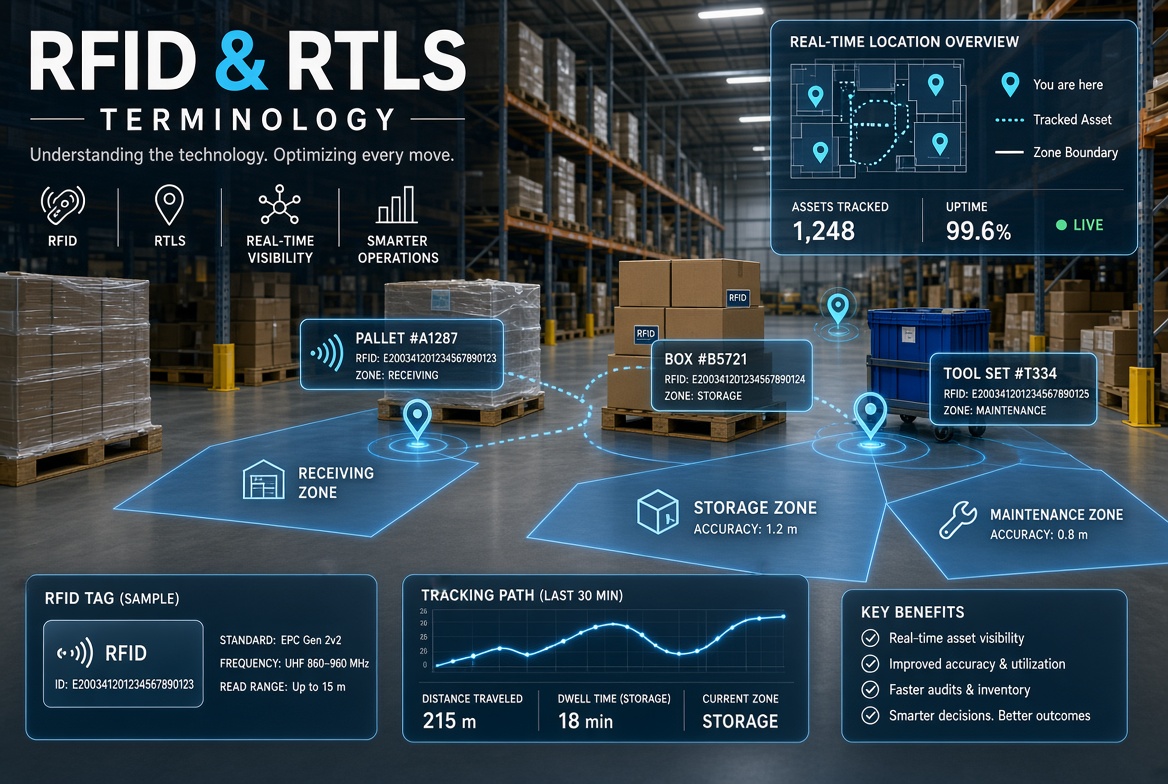
RFID + Computer Vision + POS + AI
Instead of looking at each system separately, retailers can connect the data:
RFID
→ Is the product physically present?
Scanner
→ Was the product scanned?
POS
→ Was the transaction completed?
Computer Vision
→ What actually happened at the checkout?
Exit monitoring
→ Is the product leaving the store?
This creates a much more complete picture of what is happening between product → scan → payment → exit.
What Has Improved Since 2018?
The data suggests that retailers have learned how to manage self-checkout better.
Possible reasons include:
- Customers are more familiar with SCO technology.
- Retailers have developed better interventions.
- Missed-scan detection has improved.
- Store teams have more experience managing SCO areas.
- Technology has become more sophisticated.
ECR notes that the lower losses observed in 2026 may reflect retailers becoming better at mitigating SCO losses and customers becoming more familiar with self-checkout.
But there is still a significant challenge.
The more transactions move to self-checkout, the more important accurate detection and real-time control become.
What Retailers Should Focus On Next
The 2026 report points toward four important priorities:
1. Measure SCO-specific loss
Traditional store-level shrinkage does not tell retailers exactly what happened at self-checkout.
2. Use technology to identify events
Computer vision, RFID and transaction data can potentially provide much more precise information.
3. Understand where SCO works best
Location, customer demographics, store design and utilisation levels all influence risk.
4. Measure ROI
Retailers need to evaluate the complete picture:
Labour savings + customer flow + operational efficiency − loss − inventory inaccuracies − technology costs
rather than looking at self-checkout only as a labour-saving investment.
The Future of Self-Checkout Is Not Less Technology
The 2026 report doesn’t suggest that retailers should simply remove self-checkout.
Instead, the evidence points toward a different direction:
More intelligent self-checkout.
As self-checkout becomes a larger part of retail operations, retailers will need systems that can understand not only whether an item was scanned, but whether the physical movement of the product, the scan, the payment and the final exit all match.
This is where technologies such as RFID, computer vision, AI, POS integration and real-time analytics can become increasingly important.
The objective is simple:
Reduce loss without creating friction for honest customers.
For retailers, the future is not just about making checkout faster.
It is about making checkout more accurate, measurable and intelligent.
Sources
ECR Retail Loss, Self-checkout Loss Report 2026, published June 16, 2026. The report is based on data from 39 retailers representing more than €1 trillion in combined turnover.


Leave a Reply