


Introduction
Industrial facilities and large-scale warehouses generate enormous volumes of operational data every day. Traditional RFID systems have long been used to identify and locate assets, products, and materials throughout the supply chain. However, in today’s competitive B2B environment, knowing where an asset is located is no longer enough.
The real business value comes from understanding why an asset is there, how long it will remain there, and what should happen next. This is where Artificial Intelligence (AI) transforms RFID from a data collection technology into a powerful decision-support system.
Why AI Matters in RFID Systems
RFID readers continuously collect thousands of tag reads across warehouses, production lines, and distribution centers. While this creates excellent visibility, it also generates significant amounts of raw data that require processing before they become meaningful.
Environmental conditions such as:
- Metal surfaces
- Liquid containers
- Electromagnetic interference
- Dense tag populations
- Multiple reader zones
can influence RFID read performance and generate duplicate or inconsistent read events.
Rather than relying solely on traditional rule-based filtering, AI and Machine Learning algorithms can analyze RFID event patterns, signal characteristics, timestamps, and historical behavior to improve data quality. Instead of replacing RFID technology, AI enhances the value of the data generated by RFID systems.
Machine Learning for RFID Data Optimization
Modern RFID systems generate far more information than simple tag IDs. Readers also provide valuable metadata such as:
- Signal strength (RSSI)
- Read frequency
- Timestamp
- Reader location
- Antenna ID
- Event sequence
Machine learning models analyze these parameters to distinguish genuine asset movement from duplicate or unnecessary reads.
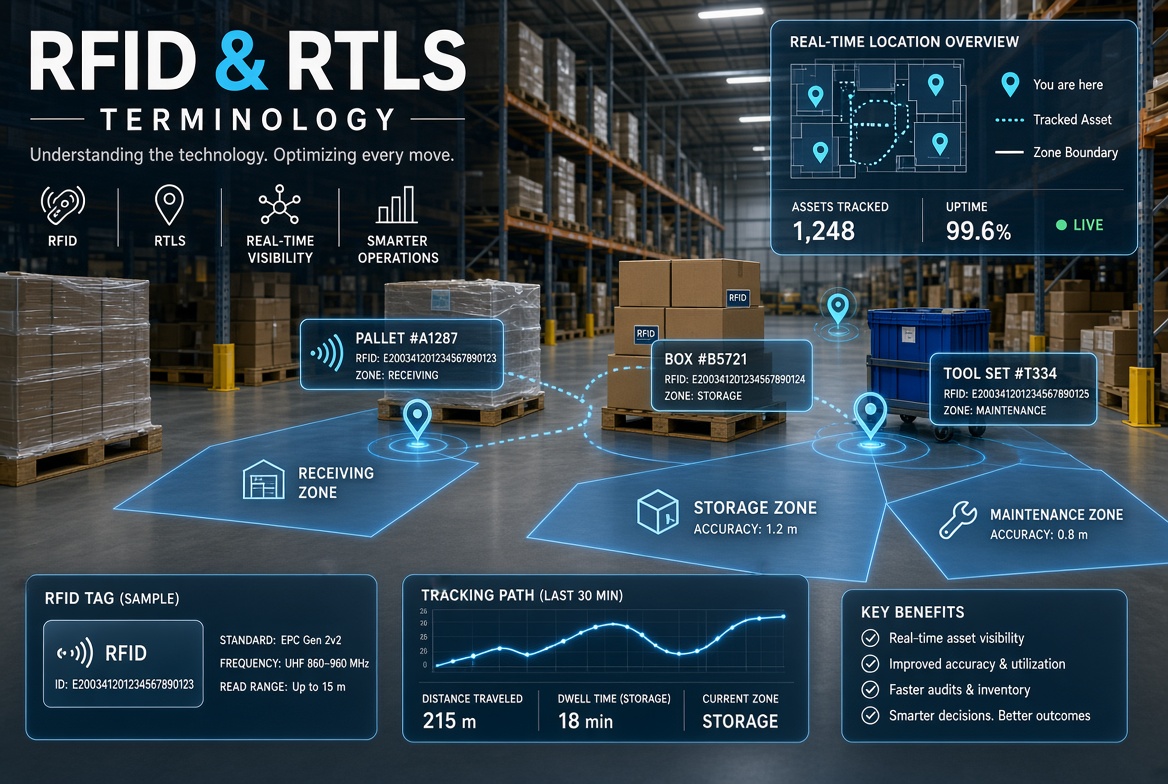
For example, AI can determine whether a pallet has actually passed through a shipping gate or is simply waiting near the loading area. This significantly improves inventory accuracy while reducing false shipping or receiving events.
Predictive Supply Chain Analytics
Traditional RFID provides real-time inventory visibility.
Artificial Intelligence goes one step further by answering questions such as:
- Which products are likely to run out first?
- Where will bottlenecks occur?
- Which suppliers may cause delays?
- When should replenishment begin?
By combining RFID data with historical consumption patterns, supplier lead times, production schedules, and ERP information, AI enables predictive inventory management instead of reactive inventory management.
Dynamic Inventory Optimization
Maintaining too much inventory ties up valuable capital, while insufficient inventory creates production interruptions.
AI continuously analyzes:
- Current RFID inventory data
- Production demand
- Supplier performance
- Seasonal trends
- Lead times
Based on this analysis, AI can generate purchasing recommendations that integrate directly with ERP or procurement systems, helping businesses optimize inventory levels while minimizing operational risk.
Demand Forecasting with RFID Data
Demand forecasting becomes increasingly difficult in industries such as:
- Automotive
- Electronics
- Retail
- Textile
- Consumer Goods
When RFID operational data is combined with external business information such as sales history, customer demand, and market trends, AI models can forecast future inventory requirements with greater accuracy.
This allows manufacturers and distributors to prepare production and logistics operations well before demand peaks occur.
AI-Powered Quality Control in Manufacturing
Every RFID-tagged component moving through a production line generates valuable manufacturing data.
AI analyzes this information to identify process anomalies.
Examples include:
- Components spending unusually long at a workstation
- Missing production steps
- Unexpected routing
- Assembly delays
- Production bottlenecks
Rather than replacing manufacturing control systems, AI provides early warnings that allow operators or Manufacturing Execution Systems (MES) to investigate potential quality issues before defects reach customers.
Error Prevention in Complex Assembly Operations
Manufacturing environments with thousands of component variations require precise material verification.
RFID ensures that the correct component is present at each workstation.
AI further analyzes:
- Assembly sequence
- Production timing
- Station performance
- Historical process data
If abnormal patterns are detected, the system can notify operators or communicate with MES or PLC systems, helping prevent costly assembly mistakes before they occur.
Predictive Maintenance with RFID
RFID technology is not limited to tracking products.
It can also identify:
- Machines
- Tools
- Production fixtures
- Spare parts
- Maintenance components
When combined with maintenance history, operational hours, and equipment performance data, AI models can estimate when critical components are likely to require maintenance.
Instead of relying on fixed maintenance schedules, manufacturers can move toward condition-based and predictive maintenance strategies that reduce unplanned downtime and improve equipment availability.
Smart Warehousing and Autonomous Logistics
Modern warehouses increasingly combine RFID technology with automation.
Autonomous Mobile Robots (AMRs), Automated Guided Vehicles (AGVs), and warehouse management systems use RFID to identify products and storage locations.
AI continuously optimizes:
- Robot routes
- Task priorities
- Traffic flow
- Picking sequences
- Storage allocation
This improves warehouse productivity while reducing unnecessary travel distances and operational delays.
RFID and Robotics
Computer vision systems sometimes struggle to identify damaged labels, poor lighting conditions, or visually similar products.
RFID provides a reliable digital identity independent of visual appearance.
By combining RFID identification with AI-based robotic control, automated systems can make better decisions regarding:
- Product verification
- Pick-and-place operations
- Material handling
- Storage destination
This combination creates a more reliable automation environment than relying on vision systems alone.
Warehouse Traffic Optimization
Large distribution centers often operate with dozens of forklifts, mobile robots, and warehouse personnel simultaneously.
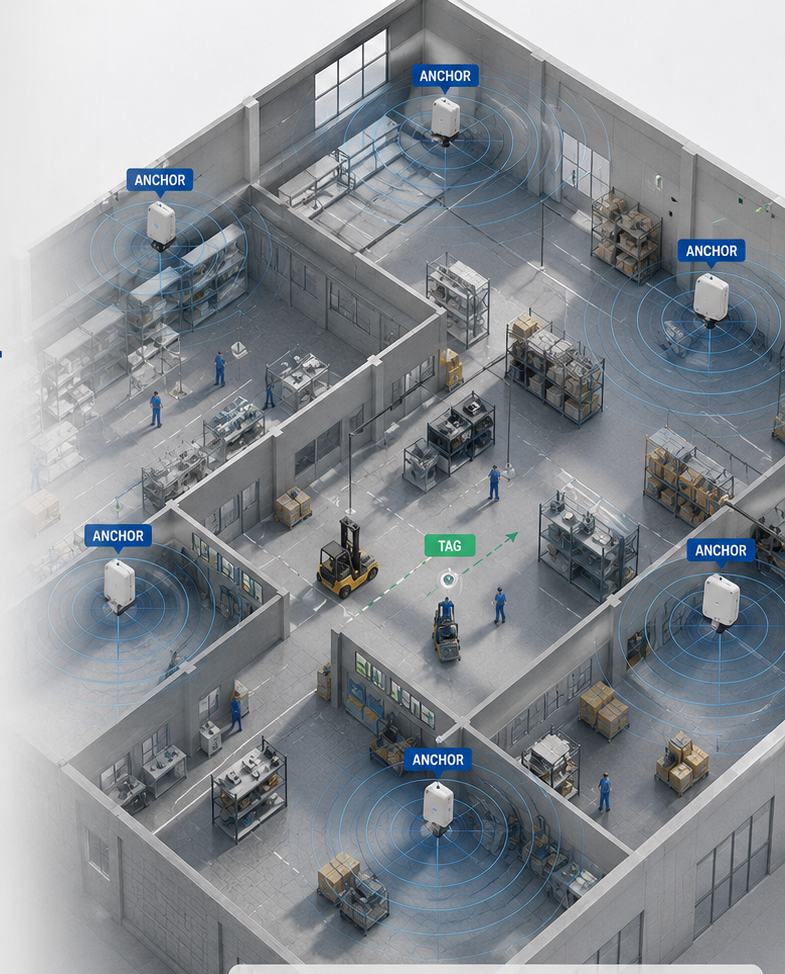
RFID infrastructure continuously provides location-related events.
AI analyzes these movement patterns to identify:
- Traffic congestion
- Inefficient warehouse layouts
- High-traffic zones
- Travel bottlenecks
These insights enable organizations to redesign warehouse layouts, improve material flow, and reduce overall transportation time.
Cybersecurity and RFID Data Integrity
As RFID systems become increasingly connected, protecting operational data becomes essential.
Artificial Intelligence can monitor RFID network activity to identify unusual patterns such as:
- Unauthorized reader access
- Abnormal tag behavior
- Unexpected data requests
- Suspicious communication events
AI acts as an additional monitoring layer that helps improve cybersecurity and operational reliability.
Detecting Counterfeit Products
Counterfeit products remain a significant challenge across global supply chains.
RFID provides every tagged item with a unique digital identity.
AI analyzes the complete movement history of each asset and can detect suspicious situations, including:
- Impossible movement sequences
- Duplicate tag appearances
- Missing manufacturing steps
- Unexpected warehouse entries
These alerts allow businesses to investigate potential counterfeit products before they enter the supply chain.
Measuring the ROI of AI and RFID
The return on investment extends far beyond hardware costs.
Organizations typically experience benefits through:
- Reduced inventory losses
- Higher inventory accuracy
- Faster asset location
- Improved labor productivity
- Lower maintenance costs
- Better production planning
- Reduced operational downtime
- Improved customer satisfaction
When properly integrated, RFID and AI become strategic investments that improve operational efficiency while supporting long-term digital transformation.
Scalability for Future Growth
One of the greatest advantages of combining RFID with AI is scalability.
As organizations expand, larger datasets enable AI models to deliver increasingly accurate predictions and operational insights.
With proper data governance and continuous model improvement, businesses can build intelligent supply chain ecosystems capable of supporting future growth and Industry 4.0 initiatives.
The Future: RFID, AI, and Digital Transformation
The future of industrial operations lies in combining multiple intelligent technologies rather than relying on a single solution.
RFID provides reliable real-world identification.
AI transforms operational data into actionable insights.
ERP, MES, IoT, robotics, and digital twin platforms convert those insights into measurable business value.
Organizations that successfully integrate these technologies will gain greater visibility, higher efficiency, improved decision-making, and a significant competitive advantage in the years ahead.
Frequently Asked Questions
Can AI improve RFID read accuracy?
AI cannot change the physical performance of RFID hardware, but it can analyze RFID event data, reduce duplicate reads, identify anomalies, and improve overall data quality.
Can AI be added to an existing RFID system?
Yes. In many cases, AI can be integrated at the software level without replacing existing RFID readers or tags, provided the system can export raw RFID event data.
Which industries benefit the most?
Manufacturing, automotive, healthcare, pharmaceuticals, logistics, retail, food production, and warehouse operations all benefit significantly from AI-enabled RFID solutions.
Does AI replace RFID?
No. RFID collects identification and location data, while AI analyzes that data to generate insights, predictions, and decision support. The two technologies complement each other rather than replace one another.



Leave a Reply