
Manufacturing is changing faster than ever before. Companies are under constant pressure to increase productivity, improve quality, reduce costs, and respond more quickly to customer demands. To remain competitive, businesses are embracing Industry 4.0 technologies that connect machines, products, and people through intelligent data.
One of the key technologies driving this transformation is RFID.
What Is Industry 4.0?
Industry 4.0 represents the fourth industrial revolution. It combines automation, digital communication, artificial intelligence, cloud computing, and the Industrial Internet of Things to create connected and intelligent production environments.
Instead of operating as isolated systems, machines, software, sensors, and products continuously exchange information in real time. This allows manufacturers to make faster decisions, optimize production processes, and improve overall efficiency.
Where Does RFID Fit Into Industry 4.0?
RFID provides the digital identity that enables physical products to communicate with digital systems.
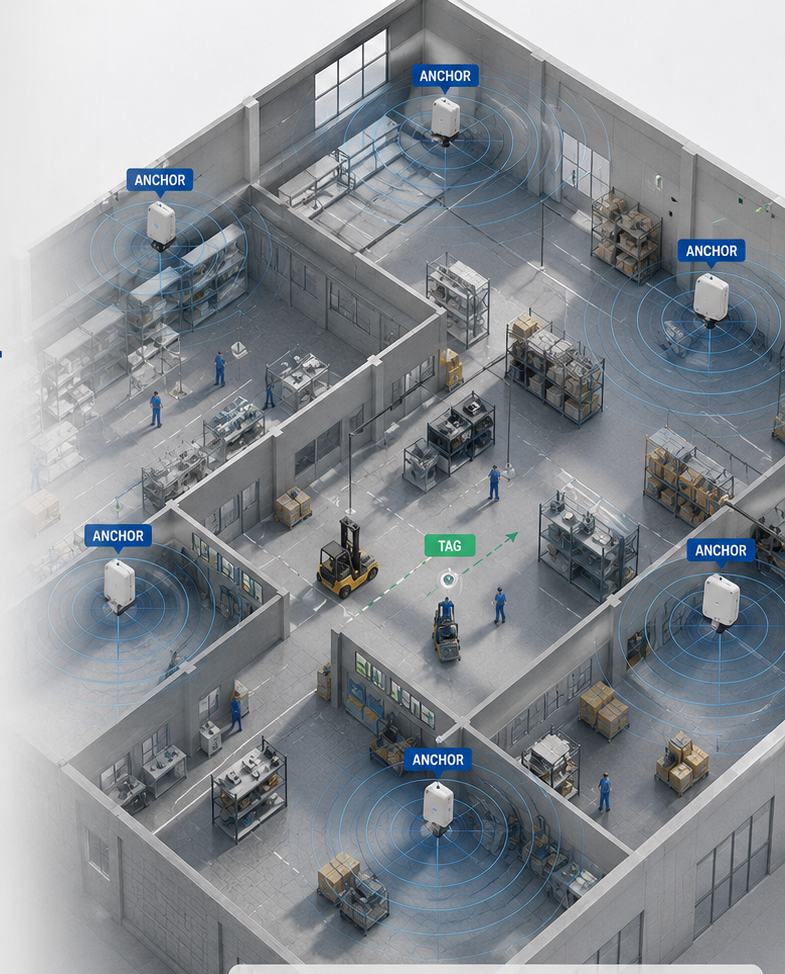
Every tagged product becomes part of a connected manufacturing environment. As products move through production, warehouses, or distribution centers, RFID automatically captures valuable information without requiring manual scanning.
This real time visibility creates the foundation for intelligent manufacturing.
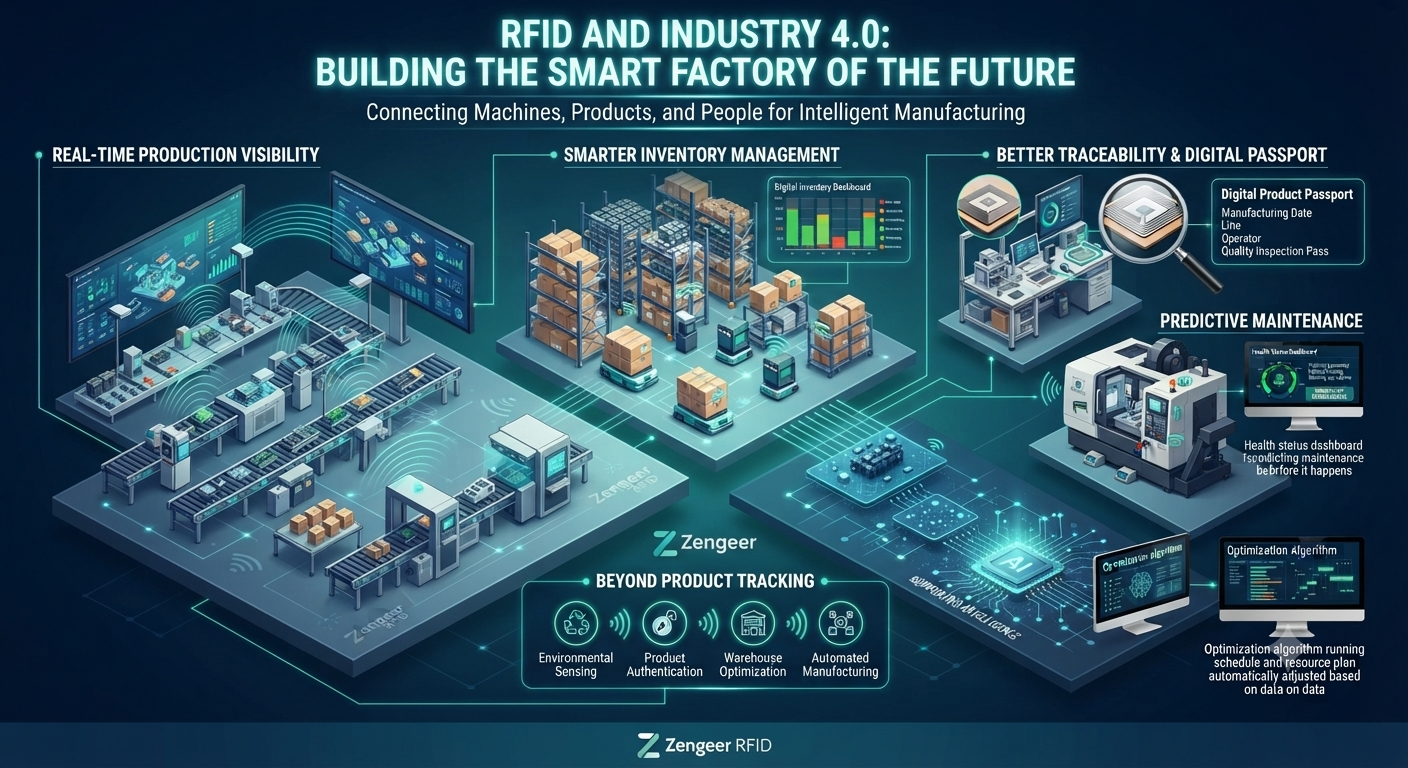
Real Time Production Visibility
One of the biggest advantages of RFID is knowing exactly where products are throughout the manufacturing process.
Instead of relying on manual reporting or barcode scanning, companies receive automatic updates whenever a product passes an RFID reader.
Production managers can instantly see where work in progress is located, identify bottlenecks, and monitor production flow across the entire factory.
Smarter Inventory Management
Traditional inventory counting is time consuming and often inaccurate.
RFID allows companies to monitor inventory continuously with minimal manual effort.
Manufacturers always know which materials are available, which components are running low, and when new inventory should be ordered.
This reduces stock shortages while preventing unnecessary overstocking.
Better Traceability
Many industries require complete product traceability.
RFID makes it possible to record every important production step throughout a product’s lifecycle.
Manufacturing date, production line, operator information, quality inspections, test results, and shipping history can all be linked to a single RFID tag.
If a quality issue occurs, affected products can be identified within seconds instead of hours.
Predictive Maintenance
Industry 4.0 focuses not only on monitoring products but also on monitoring machines.
When RFID data is combined with machine data, manufacturers can identify patterns that indicate equipment problems before failures occur.
Unexpected downtime can often be reduced through predictive maintenance strategies based on real operational data.
Supporting Artificial Intelligence
Artificial Intelligence depends on reliable data.
RFID generates large volumes of accurate, real time information that AI systems can analyze.
This allows companies to predict inventory shortages, optimize production schedules, improve resource planning, and identify process improvements that would otherwise remain hidden.
The combination of RFID and AI is becoming one of the most powerful drivers of modern manufacturing.
Beyond Product Tracking
Many people still associate RFID with simple product tracking.
Today, RFID applications extend far beyond knowing where a product is located.
Modern RFID solutions can support environmental sensing, product authentication, Digital Product Passports, automated manufacturing, warehouse optimization, and intelligent supply chain management.
RFID is evolving into a valuable source of operational intelligence rather than simply an identification technology.
Why Companies Are Investing in RFID
Companies implementing Industry 4.0 are looking for technologies that provide measurable business value.
RFID helps organizations reduce manual work, improve inventory accuracy, increase production visibility, enhance quality control, strengthen traceability, and support data driven decision making.
These benefits lead to lower operational costs, improved customer satisfaction, and greater competitiveness.
Looking Ahead
Industry 4.0 is no longer a vision for the future. It is already transforming factories around the world.
As RFID technology continues to evolve alongside Artificial Intelligence, Digital Product Passports, and smart sensors, its role within connected manufacturing environments will become even more important.
Businesses that invest in RFID today are not simply adopting another technology.
They are building the digital foundation for the next generation of intelligent manufacturing.
How Zengeer RFID Can Help
At Zengeer RFID, we support manufacturers, system integrators, and businesses throughout their RFID journey.
Whether you are planning your first RFID project, investing in RFID manufacturing equipment, optimizing production processes, or implementing a complete RFID system, we provide independent consulting and practical engineering expertise to help you make the right decisions.
The future of manufacturing is connected.
RFID is one of the technologies making that future possible.


Leave a Reply